On 7 May 1999 (23:45 Beijing time), five GPS-guided JDAM bombs released by a US B-2 strategic bomber struck the Embassy of the People's Republic of China in the Federal Republic of Yugoslavia at 3 Tresnjinog Cveta, in New Belgrade. Three Chinese citizens were killed: Xinhua News Agency reporter Shao Yunhuan, Guangming Daily reporter Xu Xinghu, and his wife, photojournalist Zhu Ying. It is one of the most painful incidents in modern Chinese diplomatic history.
This guide is a practical reference for Mandarin-speaking visitors who plan to pay their respects at the original site: precise location, the memorial's history, what to combine the visit with, and etiquette.
📷 Cover photo: Stebunik · CC BY 4.0 · Wikimedia Commons
Background
NATO launched Operation Allied Force against the Federal Republic of Yugoslavia on 24 March 1999 in response to the humanitarian crisis of the Kosovo War. The campaign was conducted without UN Security Council authorisation, and was opposed by China and Russia. Over 78 days, NATO flew 1,031 aircraft on 38,004 sorties and dropped more than 23,000 bombs on military sites, bridges, the state broadcaster and government buildings. The Serbian government estimated civilian deaths at 1,200–2,500. The Chinese embassy was the only diplomatic mission struck during the campaign.
NATO and the United States officially explained the strike as an intelligence error (“the embassy was misidentified as a Yugoslav arms procurement facility”). The Chinese government has never accepted this explanation. The three journalists were posthumously honoured as revolutionary martyrs, and US–China relations briefly fell to their lowest point since the end of the Cold War.
Exact location of the original site
Address: 3 Tresnjinog Cveta, Novi Beograd 11070, Serbia
Navigation: search directly in Google Maps, Apple Maps or the international version of Amap:
Spomen ploča kineskim novinarima(Serbian: “Memorial plaque to the Chinese journalists”)- or in English
Memorial to Chinese journalists - or in Chinese
中国大使馆纪念碑(listed on some Chinese maps)
Coordinates: 44.8164°N, 20.4167°E
Getting there from the city centre:
- Taxi: about 12 minutes from Republic Square, €6–8
- Bus: route 73 or 75 to Bulevar Mihaila Pupina stop, then a 5-minute walk
- Walking: about 25 minutes across Branko Bridge
- BALKAN CHINA NATO + Embassy half-day Mandarin guided tour: car transfers + Mandarin-speaking driver-guide commentary + Ministry of Defence ruins, €70/pax
The memorial: two monuments side by side
After the strike, the Chinese embassy moved to its current address at 6 Bulevar Mihaila Pupina, and the original site was left vacant for around a decade. In 2009 the Serbian government installed the first memorial on the site — a simple stone marker with a bilingual Chinese–Serbian inscription. In 2017, leaders of China and Serbia jointly unveiled a second, larger monument, with the names of the three journalists carved into it and a major China–Serbia friendship relief. The two monuments stand about 10 m apart and are both preserved today.
The main monument faces the original embassy plot. Fresh flowers are present year-round, left by the Chinese embassy in Serbia, the local Chinese community and visiting tour groups.
Combine your visit: government buildings hit by NATO in 1999
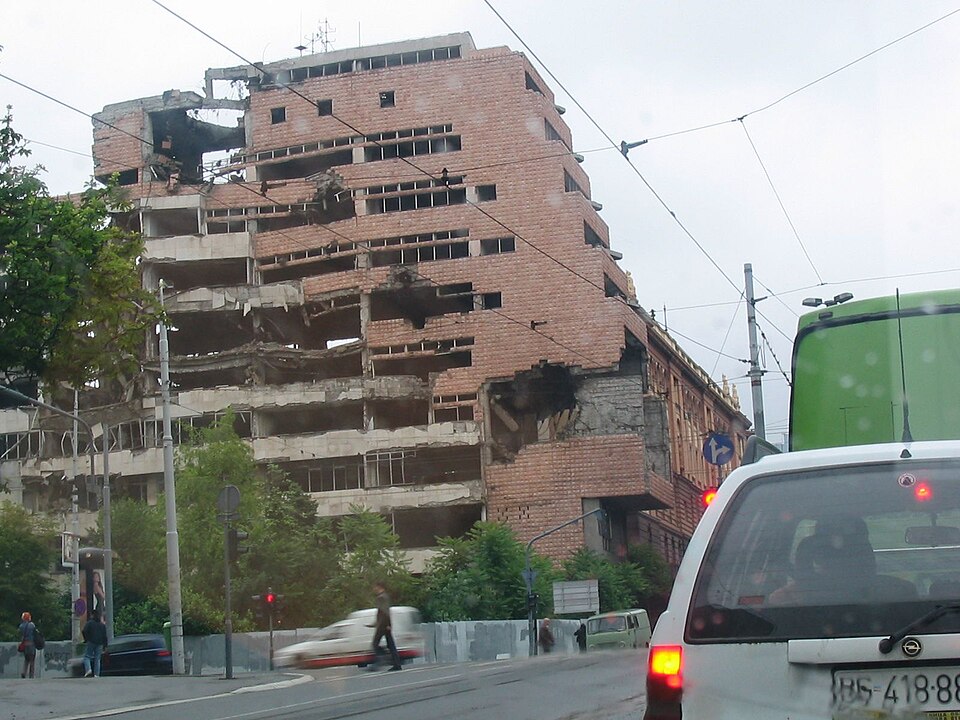
A 15-minute drive from the memorial brings you to 33–37 Kneza Miloša in central Belgrade, where you can see the bombed Serbian Ministry of Defence and Ministry of Internal Affairs ruins. NATO struck them with GBU-31 bombs on 30 April 1999, then bombed them again a week later. In 2005 the Serbian government decided to keep the ruins as a memorial — one of the largest deliberately unrestored war sites in Europe. The exposed reinforcing bars are striking in person.
Also: the Avala TV Tower on Mt. Avala was destroyed during the same campaign on 29 April 1999. The original tower had stood since 1965; it was rebuilt and reopened in 2010, with a 122 m observation deck open to visitors today.
Best time to visit
- 7 May each year: anniversary day. The Chinese embassy and Serbian government hold an annual flower-laying ceremony. To take part, contact the consular office of the Chinese embassy in advance.
- Other days: the memorial is open-air and accessible 24 hours. We recommend 07:00–09:00 or 17:00–19:00 for soft light and fewer visitors.
- Avoid: 11:00–15:00 on weekends in high season (May–September), when large groups arrive together.
Etiquette (important)
- Dress: dark or muted clothing. Avoid red or highly saturated colours.
- Posture: please do not pose with smiles, V-signs or jumping shots in front of the memorial — both the Chinese community and Serbian police find this deeply inappropriate.
- Flowers: there are flower shops at the corner of Tresnjinog Cveta street. Carnations, white chrysanthemums and white lilies are appropriate choices.
- Silent tribute: stand silently for at least one minute, and consider reading aloud the names Shao Yunhuan, Xu Xinghu and Zhu Ying.
- Ministry of Defence ruins: photographs from across the street are fine, but you may not enter the ruins themselves (still a controlled government zone).
Additional notes for Mandarin-speaking visitors
1. Journalists or scholars on a research visit: contact the consular office of the Chinese embassy in Serbia in advance for deeper access.
2. Families bringing students for educational visits: watch a relevant documentary together first, then pay your respects on site — the background context makes the experience much more meaningful.
3. Book a Mandarin-language guide — visiting on your own can feel like a quick check-the-box stop. A Mandarin-speaking driver-guide can walk you through the strike, Serbia's political response and the subsequent upgrade of China–Serbia relations — a half day spent this way leaves you with a fundamentally different understanding. The BALKAN CHINA NATO + Embassy half-day Mandarin tour is a tailored product at €70/pax.
Want broader background on the 1999 incident? See 1999 Chinese Embassy Incident: Places You Should Visit (with practical guide).