At 11:45 p.m. Beijing time on 7 May 1999, five NATO Joint Direct Attack Munitions (JDAMs), released from a U.S. B-2 bomber, struck the Chinese Embassy in Yugoslavia at 3 Tresnjinog Cveta in Belgrade. Three Chinese citizens were killed — Xinhua correspondent Shao Yunhuan, Guangming Daily correspondent Xu Xinghu and his wife, photojournalist Zhu Ying — and more than 20 people were wounded. It remains one of the heaviest moments in the diplomatic history of the People’s Republic of China.
Why this stop matters specifically to Mandarin-speaking visitors
For Chinese born in the 1970s and 1980s — many of them students at the time — the night of 7 May 1999 is a shared memory. From that day forward the name “Yugoslavia” was bound up in Chinese minds with phrases like “old friend,” “a small country pushed around by the powerful,” and the partisan film Walter Defends Sarajevo. That collective resonance does not exist for English, Serbian or other Western travelers.
That is why this stop is an emotional anchor unique to the Chinese-speaking market — one no other country’s tour can replicate. The most common scene we see is a family in their 50s or 60s bringing along a now-grown child to pay a quiet visit, then talking about where they were in their twenties. For many travelers, it is the most personal moment of the entire Serbia trip.
Background to the event
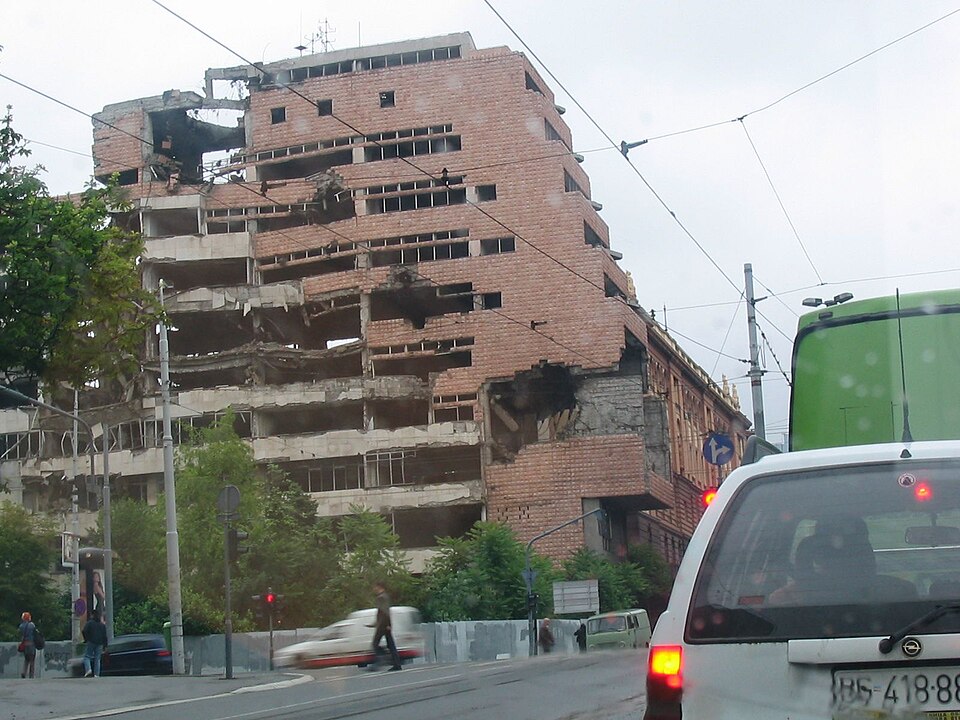
📷 Stebunik · CC BY 4.0 · Wikimedia Commons
NATO launched Operation Allied Force against the Federal Republic of Yugoslavia on 24 March 1999, citing the humanitarian crisis in the Kosovo war. The campaign lasted 78 days. During the strikes of 7 May, the Chinese Embassy was the only diplomatic mission hit. NATO and the United States officially attributed the strike to a targeting error based on faulty intelligence; the Chinese government has never accepted that explanation, and the three journalists killed were posthumously honored as martyrs.
The original embassy site and the memorials
The original embassy stood at 3 Tresnjinog Cveta in Novi Beograd (New Belgrade). After the bombing, the embassy was relocated to its current address at 6 Bulevar Mihaila Pupina. The original lot lay vacant from 1999 to 2009, when the Serbian side erected a first bilingual Chinese-Serbian memorial plaque. In 2017 the leaders of China and Serbia jointly unveiled a second, larger memorial inscribed with the names of the three journalists.
Navigation tip: search Google Maps or Apple Maps for “Spomen ploča kineskim novinarima” or “Memorial to Chinese journalists.” There is no metro; the closest public transport is bus 73 or 75 to Bulevar Mihaila Pupina.
A suggested walking and driving route
📷 Petit.Madeleine · CC BY-SA 4.0 · Wikimedia Commons
- Memorial to the three journalists (3 Tresnjinog Cveta) — a moment of silence and a flower offering. Several florists nearby on Tresnjinog Cveta can supply bouquets.
- Current Chinese Embassy (6 Bulevar Mihaila Pupina, about a 12-minute walk) — view from across the street only; photography at the embassy gates is not permitted.
- Ruins of the Serbian Ministry of Defence and Ministry of Internal Affairs (Kneza Miloša 33–37, about 15 minutes by car) — both buildings were also struck in 1999 and have been left in their bombed state as one of the largest deliberately unrestored war sites in Europe. The two structures face each other; the exposed steel framing is striking.
- Tašmajdan Park and St. Mark’s Church (about a 10-minute walk) — a quiet place to decompress.
When to visit
- 7 May each year: the anniversary. The Chinese Embassy in Serbia and the Serbian government hold an annual wreath-laying ceremony. If you would like to attend, contact the consular section of the Chinese Embassy in advance.
- Other days: the memorial is open 24 hours. Early morning or late afternoon offers softer light and far fewer visitors.
- Avoid: weekends and the 11:00–15:00 window in peak season, when large groups tend to arrive together.
Do you need a Mandarin-speaking guide?
The memorial itself has no on-site interpreter and no information panels. If you want to understand:
- The full sequence of events (the 78-day NATO campaign, the timeline of 7 May, the Chinese government’s response)
- The political context behind both memorials (2009 vs. 2017)
- The other Serbian government buildings struck in the same campaign (Ministry of Defence, Ministry of Internal Affairs, the state TV building)
- The key milestones in the China–Serbia diplomatic upgrade that followed
…we strongly suggest booking the BALKAN CHINA half-day Mandarin-led memorial tour. Our Mandarin-speaking driver-guide is a Chinese national who has lived in Serbia for years (note: not a licensed Serbian Tourist Guide Association interpreter). The four-hour itinerary walks you from the memorial to the Ministry of Defence ruins with full commentary, and includes vehicle transfers, bottled water, and flower arrangement on request.
To round out the “Yugoslav memory” chapter of your trip, consider the upgraded Yugo classic car + Red Belgrade + 1999 embassy site half-day — the same four hours, but built around a vintage Yugo Zastava, Tito’s mausoleum, and Brutalist architecture. It traces the arc from Yugoslavia’s grand state projects to its iconic people’s car to the night the embassy was struck.
Practical notes
1. Dress in dark or muted tones; avoid red or highly saturated colors.
2. Do not pose with smiles or peace-sign gestures in front of the memorial — both the local Chinese community and Serbian police consider it disrespectful.
3. You may photograph the Ministry of Defence ruins from outside, but cannot enter the structures (they remain a Serbian government restricted area).
4. If you are visiting as a journalist or academic researcher, contact the consular section of the Chinese Embassy in Serbia in advance to arrange deeper access.