If you only photograph one building in Belgrade, it should be the Genex Tower (Serbian: Geneksov Toranj; official name Western City Gate / Западна капија Београда). This pair of facing twin towers is not just a flagship of Yugoslav brutalism — it is a visual manifesto of the worker self-management socialist economy. This guide gives Mandarin-speaking travellers everything they need to visit.
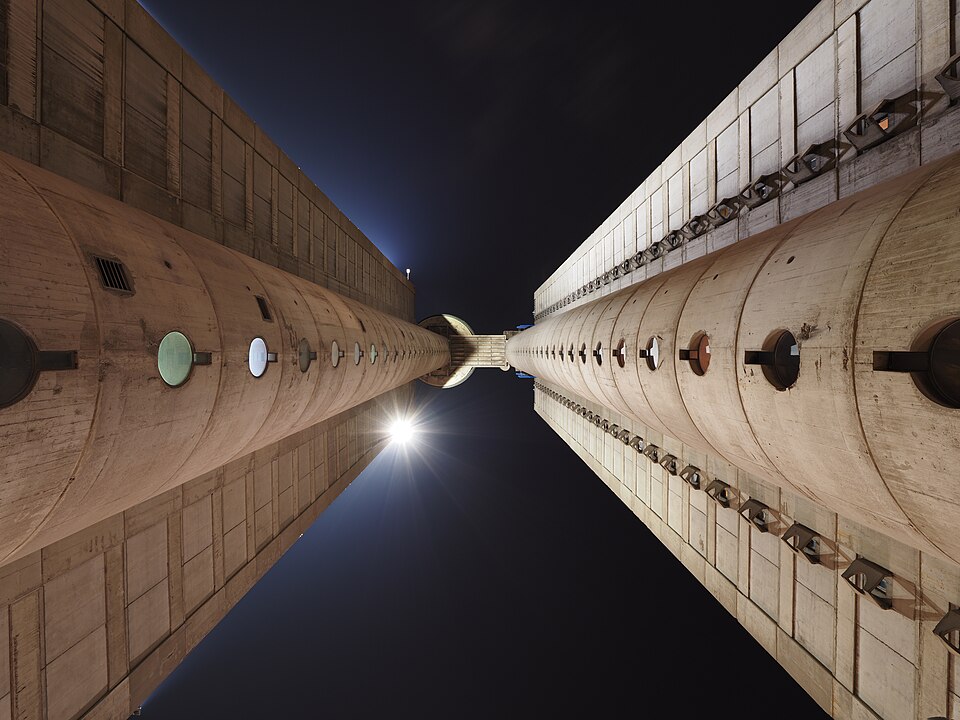
📷 Cover photo: Petar Milošević · CC BY-SA 4.0 · Wikimedia Commons
What it is: twin towers, 35 floors, a former revolving restaurant on top
The Genex Tower stands on the western edge of New Belgrade (Novi Beograd), right on the highway leading to BEG airport. The complex consists of a 30-floor residential tower and a 35-floor commercial tower, linked by a two-storey sky bridge, with a once-revolving restaurant on top (out of service for years). At 140 m, it was for a long time the tallest building in Belgrade.
The official name “Western City Gate” refers to its position facing the western approach into the city — for anyone driving into Belgrade from the west, these two towers are the first thing they see, forming a symbolic gateway.
History: from state trade giant to half-empty heritage
The Genex Tower was designed by Serbian architect Mihajlo Mitrović, broke ground in 1977 and was completed in 1980. The client was the state-owned Yugoslav trade conglomerate Genex — at the time the largest multinational trading company in Yugoslavia, active in more than 70 countries across food, textiles, machinery and arms. Genex was a textbook example of Yugoslav worker self-management socialism: employees held a share of management rights, but the company remained state-owned.
After the federation broke up in 1991, the Genex group went bankrupt in 2003. Both towers were left largely vacant, the revolving restaurant closed, and the facade fell into disrepair. In 2021 the Serbian government listed the Genex Tower as a protected cultural monument, and parts of the floors have since been refurbished into creative studios and a hotel. It remains the defining symbol of the New Belgrade skyline.
Architecture: a textbook of brutalism
Brutalism was the dominant European architectural movement from the 1950s to the 1980s, marked by large expanses of bare concrete, sharply geometric forms and a rejection of ornament. The Genex Tower carries almost every one of these traits:
- Asymmetric twins: a 35-floor commercial tower and a 30-floor residential tower, expressing two different programmes
- Sky bridge: a two-storey bridge connects the towers near the top, both decorative and an evacuation route
- Rooftop revolving restaurant: a rare touch in 1980s Yugoslavia, completing one rotation every 90 minutes
- Sculpted facade: each floor's exterior wall steps outward, creating strong horizontal lines and shadows
This “monumental scale plus industrial feel” is a sibling of the same-era socialist architecture familiar to many Chinese travellers — the old terminals at Beijing's airports and the original Beijing West Railway Station hall belong to the same family.
How to visit: photo angles and inside access
Best exterior viewpoints:
- From the east bank approach over Brankov Bridge — looking west from the bridge, the twin towers and sky bridge form a perfect triangular composition. Light is best at sunset (17:00–19:00).
- Yurija Gagarina street, looking up — head-on at the base of the towers gives a strong perspective effect.
- South bank of the Sava — after the facade lights come on at night, the silhouette stands out sharply.
Inside access: the lobby of the commercial tower and selected floors are open to the public. The revolving restaurant does not operate and the top floor is closed to visitors. To go inside, the ground-floor cafe lets you see the original lobby and lift hall.
Time needed: 15–30 minutes for an exterior loop and photos.
How to get there: 5 ways
| Option | Time | Cost |
|---|---|---|
| Taxi from city centre | ~12 min | ~600 RSD (€5) |
| Bus 96 / 707 | ~25 min | 89 RSD (€0.8) |
| Taxi from BEG airport | ~8 min | ~800 RSD (€7) |
| Walk from south bank of the Sava | ~30 min | Free |
| BALKAN CHINA Tito-themed tour | Included in 4h tour | €60/pax |
Pair it with: 3 nearby brutalist landmarks
- SIV / Palata Srbija (Federal Executive Council building, 1959) — 5 minutes by car, host of the 1961 Non-Aligned Movement summit
- Sava Centar congress hall — 1980s brutalism mixed with modernism, host of the 1980 OPEC summit
- Block 23 workers' housing — the residential face of the same era's brutalism, a state-built worker apartment estate
Practical tips for Mandarin-speaking travellers
1. Avoid going alone late at night — the surrounding New Belgrade blocks are quiet after dark; visit between 10:00 and 17:00.
2. The exterior gives you all the best photos — the interior offers little extra.
3. Strong emotional hook for travellers who lived through the 1960s–70s in China — while you photograph, you can talk through Yugoslav worker self-management, Genex's multinational ambitions and the parallel fate of China's state trading companies.
4. Best value as part of a themed tour — a solo round-trip taxi plus photo stop runs over €10; combining it into our 4-hour Tito-themed tour (€60/pax, with House of Flowers + 25 May Museum + Genex Tower + Mt. Avala) is much more economical.
Want more on Tito and Yugoslavia? Read our 30-Minute History of Tito and Yugoslavia for Chinese Travellers.