In Belgrade's Dedinje neighbourhood stands a quiet mausoleum converted from a winter garden, the resting place of Yugoslav head of state Josip Broz Tito (1892–1980) and his wife Jovanka Broz. This is the House of Flowers — in Serbian Kuća cveća, literally “the flower house”. This guide gives Mandarin-speaking visitors everything they need to know.
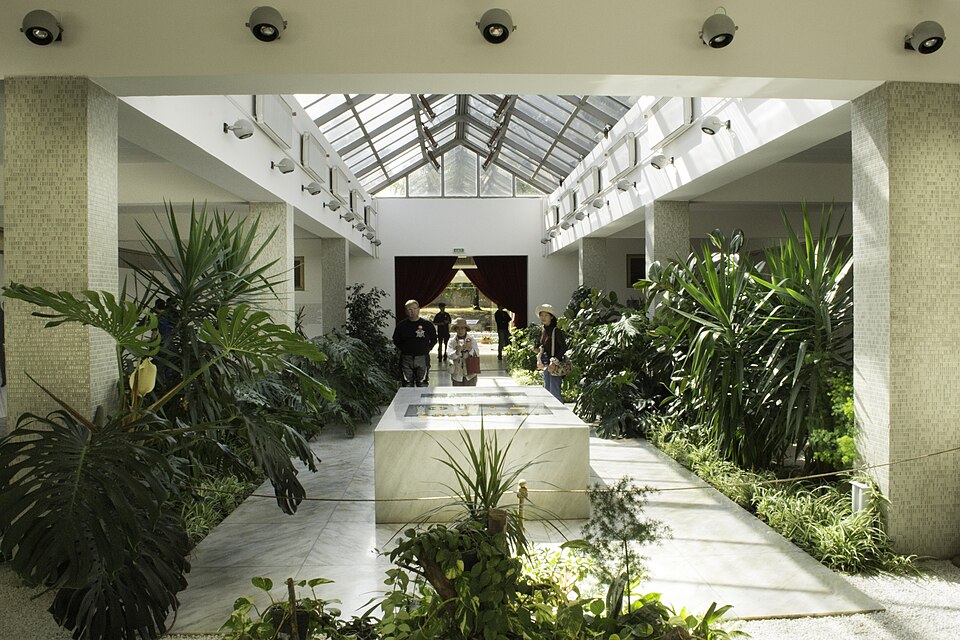
📷 Cover photo: Kenzavi (Cvetanović Igor) · CC BY-SA 3.0 · Wikimedia Commons
What it is: from a winter garden to a state mausoleum
The House of Flowers sits in the affluent Dedinje area of southern Belgrade, inside the grounds of the Museum of Yugoslavia. The building was originally a private winter garden built for Tito in 1975, with a central glass house and two flanking corridors. The flowers blooming year-round in the garden gave the building its name.
When Tito died in May 1980, his body was, at his personal request, interred in the centre of the flower house. In 2013, after the death of his wife Jovanka Broz (the former first lady of Yugoslavia), she was buried beside him.
The floor of the main hall bears a single inscription: “Josip Broz Tito 1892–1980”. Spare and solemn, with no statues or ornament — faithful to Tito's personal style.
Background: 25 May, Youth Day
Every 25 May — Tito's official birthday (his actual birthday was 7 May, but the 25th was adopted as Yugoslav Youth Day) — nostalgics from the former Yugoslav republics (Serbia, Croatia, Bosnia, Slovenia, North Macedonia, Montenegro) gather at the House of Flowers to lay flowers.
From 1957 to 1991, Yugoslavia held a nationwide youth relay run on 25 May (Štafeta mladosti) — young people carried a baton from each constituent republic back to Belgrade, and the final runner handed the baton to Tito himself. Today the entrance corridor of the House of Flowers displays the original batons from 1957 to 1986, an irreplaceable physical archive of 20th-century Yugoslav youth culture.
Location, tickets, hours
- Address: 6 Botićeva, 11000 Beograd, Serbia (Dedinje district)
- Hours: Tuesday–Sunday 10:00–18:00 (closed Mondays)
- Tickets: adult 400 RSD (~€3.5); includes the Old Museum and the 25 May Museum on the same site — excellent value
- Guided tours: self-guided by default; add 1,000 RSD for a Mandarin or English guide (book 24 hours in advance)
- Getting there:
- Taxi: about 15 minutes from the city centre, €8–10
- Bus: 40 / 41 / 47 to Topčidersko Brdo, then an 8-minute walk
- BALKAN CHINA 4-hour Tito-themed tour: House of Flowers + 25 May Museum + Genex Tower + Mt. Avala, €60/pax
Inside the mausoleum: what to see
- Main burial hall — the joint resting place of Tito and Jovanka. The names are carved into the floor; the tombs are surrounded on all four sides by the glass house. Walk the perimeter clockwise.
- Gift hall (around the main hall) — a selection of diplomatic gifts received by Tito, including ink paintings and porcelain from Chairman Mao, a cigar box from Castro, a pyramid model from Nasser, and a porcelain plate from Kennedy.
- Relay-baton wall (in the entrance corridor) — the original Youth Day batons from 1957 to 1986.
- Garden — an extension of Tito's original winter garden, with year-round flowers; a strong photo spot.
Etiquette
- No laughter, hats or loud conversation inside the mausoleum.
- No flash photography (to protect the flowers and exhibits).
- Do not touch the display cases in the gift hall.
- Photography is allowed in the main hall, but no “tourist-pose” group shots — please observe a quiet tribute.
Notes for Chinese visitors
Historical hooks: the House of Flowers carries several distinctive emotional connections for Chinese visitors:
- Deng Xiaoping personally attended Tito's funeral in Belgrade in May 1980, a key moment in the repair of China–Yugoslavia relations
- The gifts Chairman Mao sent to Tito are still on display in the 25 May Museum — you can see them in person
- The “non-Soviet model of socialism” that Tito represented had an indirect influence on China's reform and opening-up in the 1980s
- The first Non-Aligned Movement summit was held in Belgrade in 1961, founded jointly by Tito, Nehru, Nasser, Sukarno and Nkrumah; China did not join, but followed it closely
This context lifts the visit from quick sightseeing to genuine understanding. Our 4-hour Tito-themed Mandarin tour threads this entire history together for €60/pax.
Want broader history on Tito and Yugoslavia? Read our 30-Minute History of Tito and Yugoslavia for Chinese Travellers.