Painters who hid themselves inside their own paintings
In a number of films that have since become classics, the celebrated British director Alfred Hitchcock had a habit: he would appear on screen for just a few seconds — as a passer-by, a member of the crowd, a passenger on a train, someone crossing the street, a street musician playing the double bass, a gentleman walking his dog, a man buying a newspaper, and so on. This witty and very personal cinematic “Easter egg,” which he popularised within the history of film, in fact has roots in art history that long predate both Hitchcock and the cinema itself.
Many artists, painters above all, have inserted themselves into their own works in distinctive ways: as an anonymous bystander, or as the protagonist or witness within the scene. They conceal themselves with skill, dressing up as other characters, casting a subtle glance toward the viewer, or turning toward a corner of the canvas — not seeking a simple (self-)portrait, but rather conveying a personal message, often rooted in their own real-life experiences and circumstances.
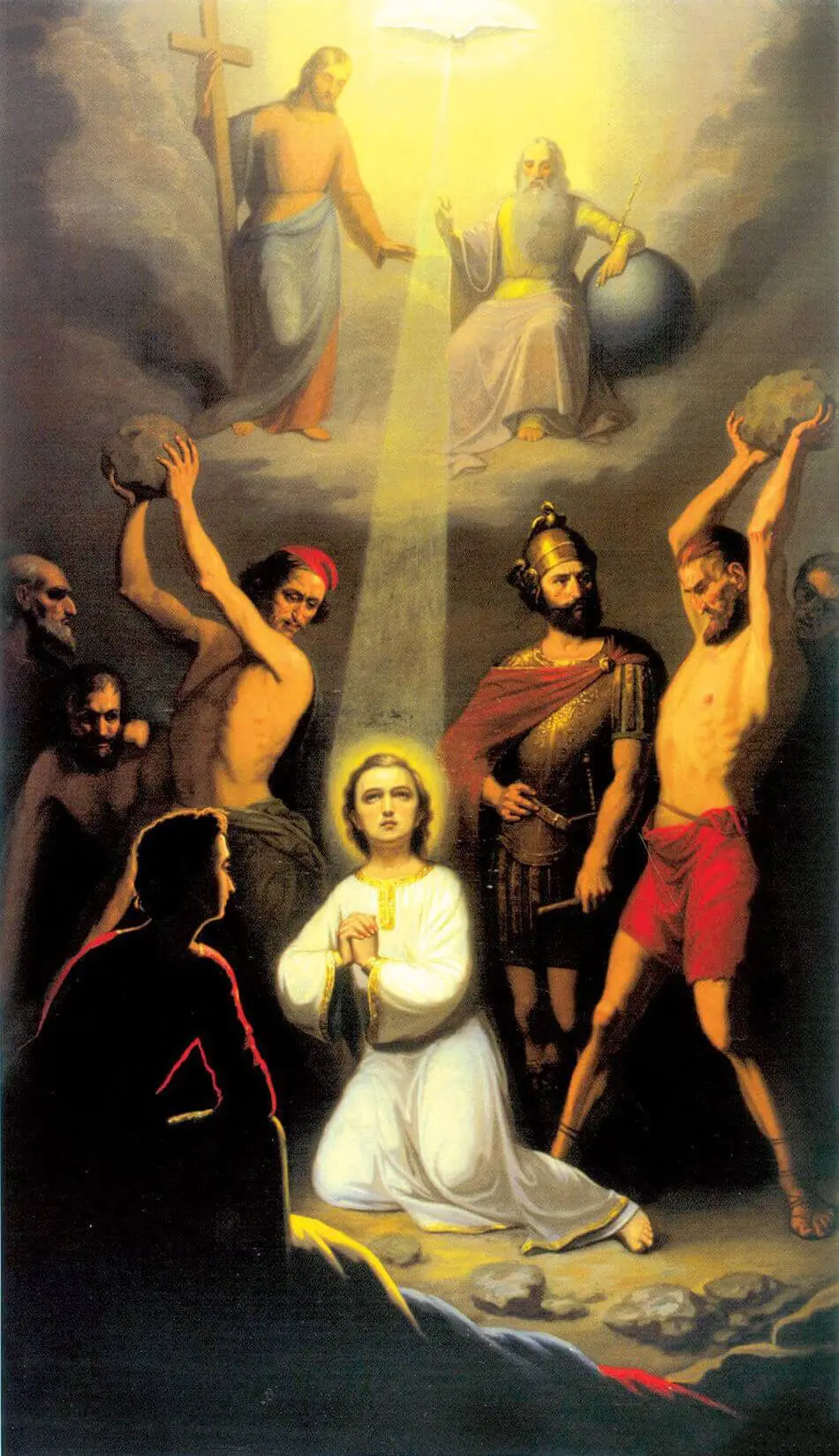
Stoning of Saint Stephen, a religious oil painting by the 19th-century Serbian painter Novak Radonić
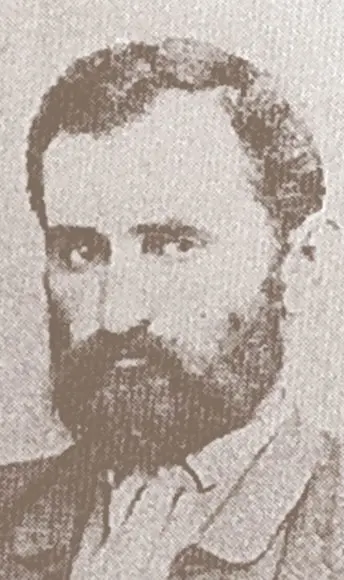
Novak Radonić
Reading the painting:
Central figure: the young man in white, kneeling on the ground, is Saint Stephen, the first Christian martyr (see Acts 7). He is praying with devotion, while a holy light descends from above, symbolising the ascent of his soul.
The light from above: at the top of the painting, God the Father and Jesus Christ appear together in heaven, sending down the Holy Spirit (in the form of a dove) to receive Stephen’s soul.
Surrounding figures:
- An angry mob with raised stones, ready to put him to death, surrounds him.
About the painter:
-
Novak Radonić
- A 19th-century Serbian Romantic painter.
- Scholars believe that in this work he portrayed himself as the executioner on the right, raising a stone, a gesture loaded with deep penitence and inner religious conflict.
- In his early years he studied in Italy, where he was profoundly influenced by religious masters such as Raphael. Later, feeling his own gifts to be limited, he was overcome by discouragement and at one point gave up painting altogether.
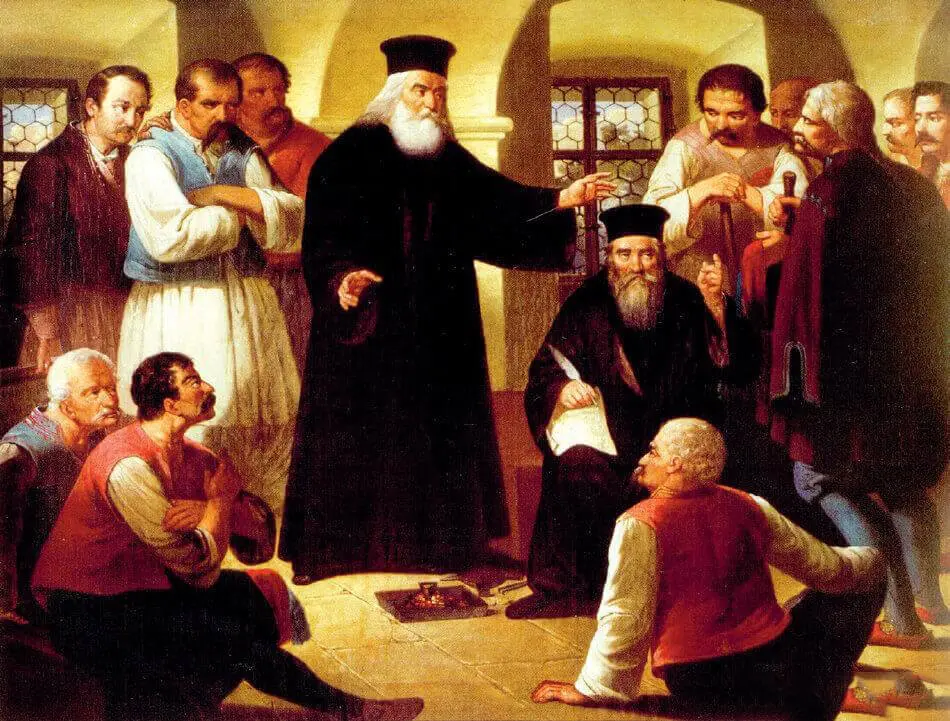
Hadži Ruvim and Hadži Đera, painted by Pavle Simić in 1849 (original title: Hadži Ruvim i Hadži Đera)
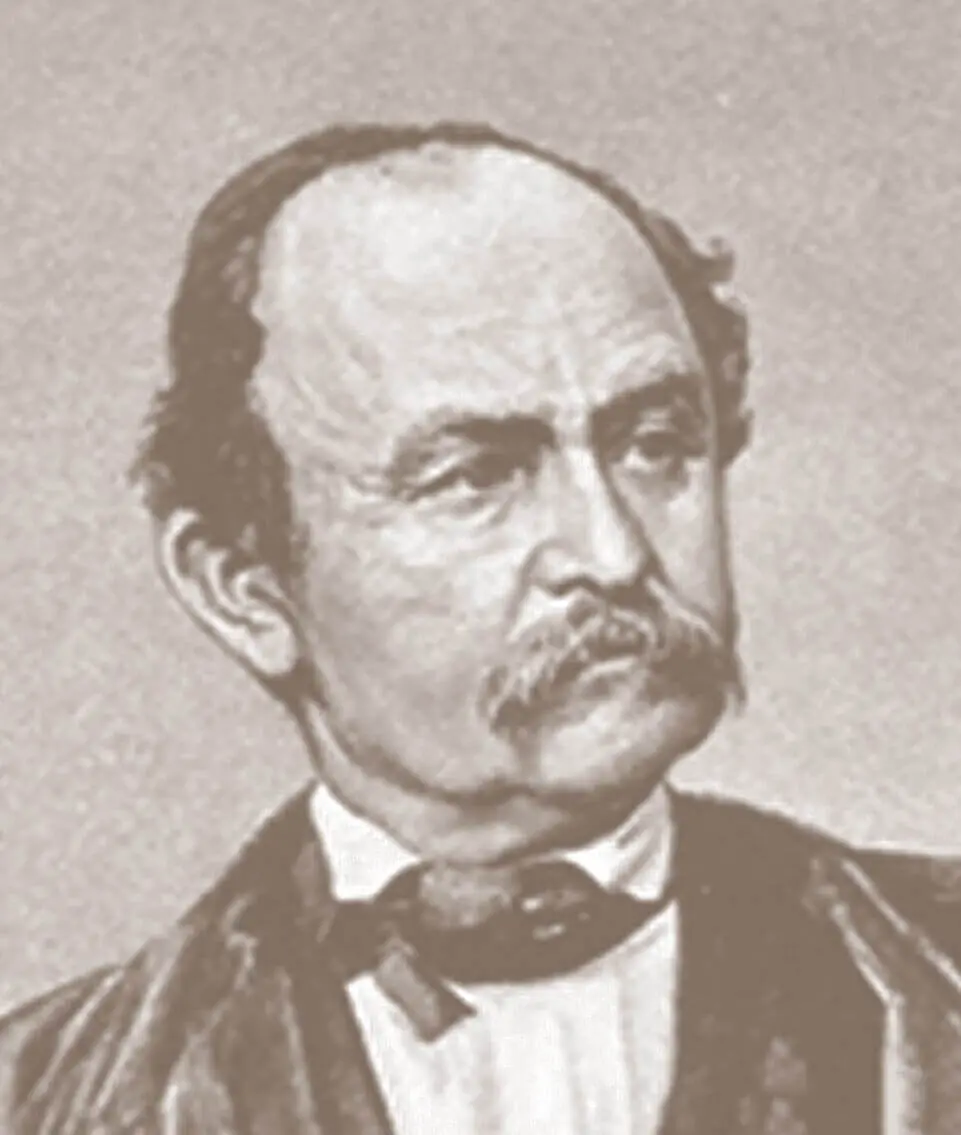
Pavle Simić
Background and reading of the painting:
-
Subject: the painting depicts the historical scene of two Serbian Orthodox clergymen — Hadži Ruvim and Hadži Đera — drafting a letter to the Ottoman Sultan on the eve of the uprising.
- They were leading national-religious figures on the eve of the First Serbian Uprising of 1804, and were actively involved in the political preparations for resistance against Ottoman rule.
-
Composition:
- Standing at the centre of the painting is Hadži Ruvim, addressing those around him with intense focus, as if dictating or drafting a crucial letter.
- Seated nearby, Hadži Đera is taking it down in writing.
- The crowd around them shows a range of expressions: tension, perplexity, but also resolve and expectation.
- The figure on the left, by the window, is believed to be a self-portrait of the painter Pavle Simić, who placed himself within the historical event as a “witness” to this moment of national awakening.
About the painter:
-
Pavle Simić (1818–1876)
- A celebrated 19th-century Serbian painter, often described as “the Serbian representative of the Nazarene movement.”
- He produced not only religious frescoes and icons (iconostases, church altarpieces) but also devoted himself to subjects drawn from national history.
- He was among the first Serbian artists to “paint himself into” a historical event as one of its witnesses.
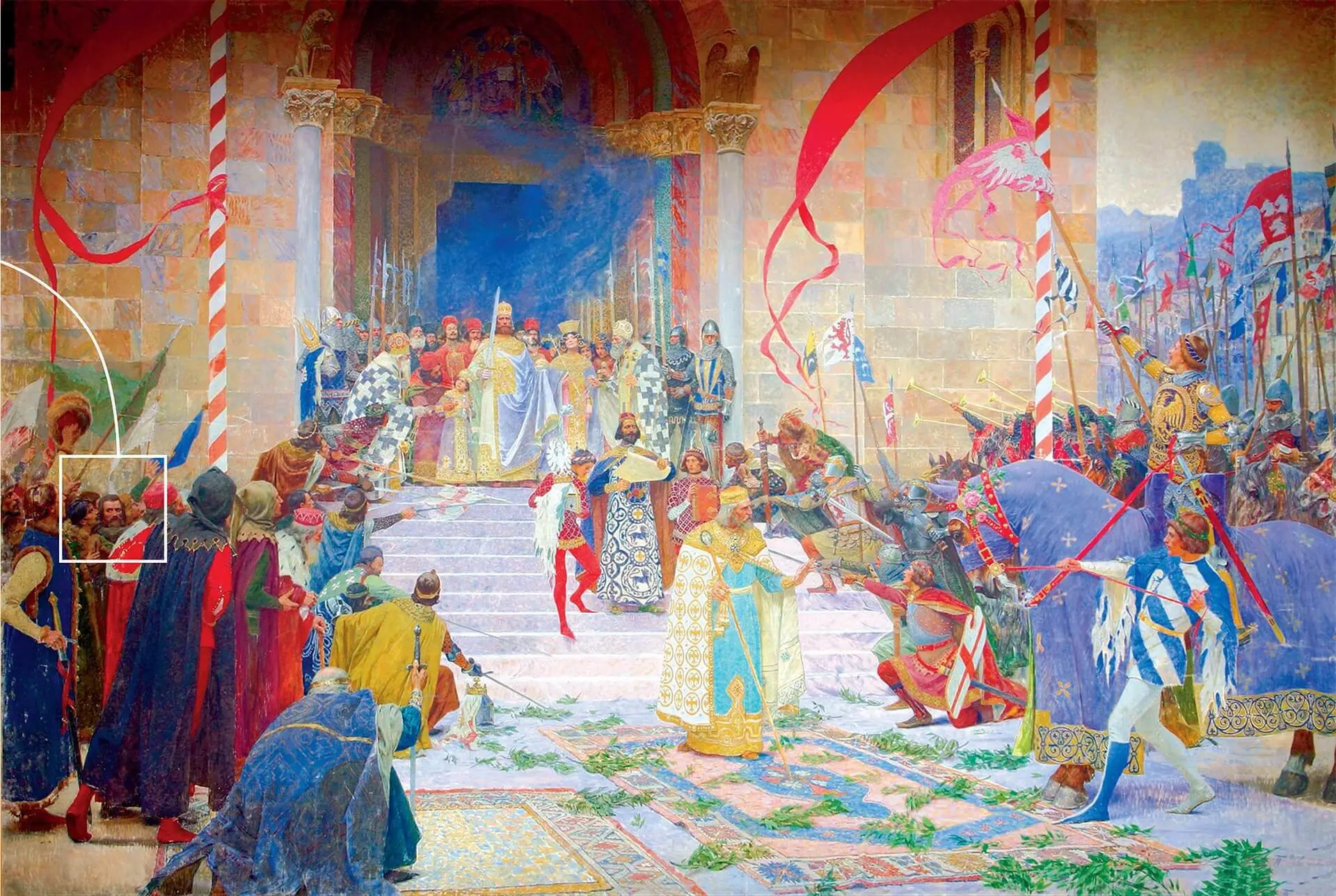
This work is a monumental history painting by the renowned Serbian artist Paja Jovanović (1859–1957).
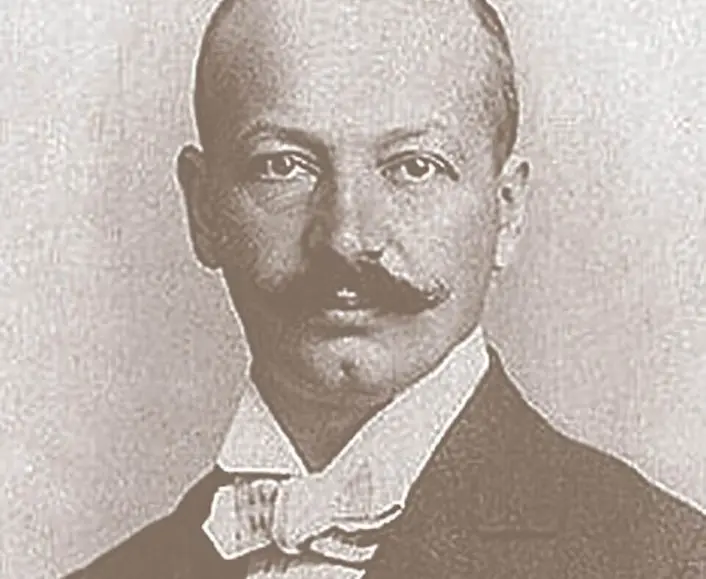
Paja Jovanović (1859–1957)
The Coronation of Tsar Dušan
Original title: Крунисање цара Душана / Coronation of Tsar Dušan
Date: 1900
Medium: oil on canvas
Dimensions: monumental (about 18 square metres)
First exhibited: 1900, Serbian Pavilion at the Paris Universal Exposition
A brief historical note:
The painting depicts the moment in 1346 when Stefan Uroš IV Dušan, the greatest medieval Serbian sovereign, was crowned emperor. In Peć, surrounded by the Orthodox patriarch and the highest nobles, he was proclaimed “Emperor of the Serbs and the Greeks,” formally founding the Serbian Empire.
Reading the painting:
- At the centre: Emperor Dušan, in a golden imperial robe, receives the crown surrounded by the patriarch and bishops.
- On the steps to either side: guests of every rank, soldiers, clergy, heralds and nobles are gathered together.
- Knights and soldiers on the right: a display of Serbia’s military strength and the order of the empire.
-
Among the spectators on the left:
- There stands a dark-haired man in a green tunic and a red cloak, his gaze steady, looking straight out at the viewer.
- He is slightly out of step with the “period style” of the rest of the painting, his bearing more modern, natural and composed.
- He is widely held to be the artist Paja Jovanović himself, hidden in the painting as a self-portrait.
The artist’s art of “hiding the self”:
This work is a classic example of what we described earlier as the painter casting himself as a witness. In this scene of imperial coronation at the height of the Serbian Empire, Paja Jovanović placed himself within the company in the guise of a “noble emissary”:
- At once “the painter of history” and “a participant in the event”;
- He weaves the presence of the individual artist into a narrative of national glory;
- He conveys his own engagement with, and witness to, “the destiny of the nation and its cultural identity.”
“To leave a shadow of oneself within a grand narrative is among the most tender, and the most resolute, of an artist’s acts of self-expression.”
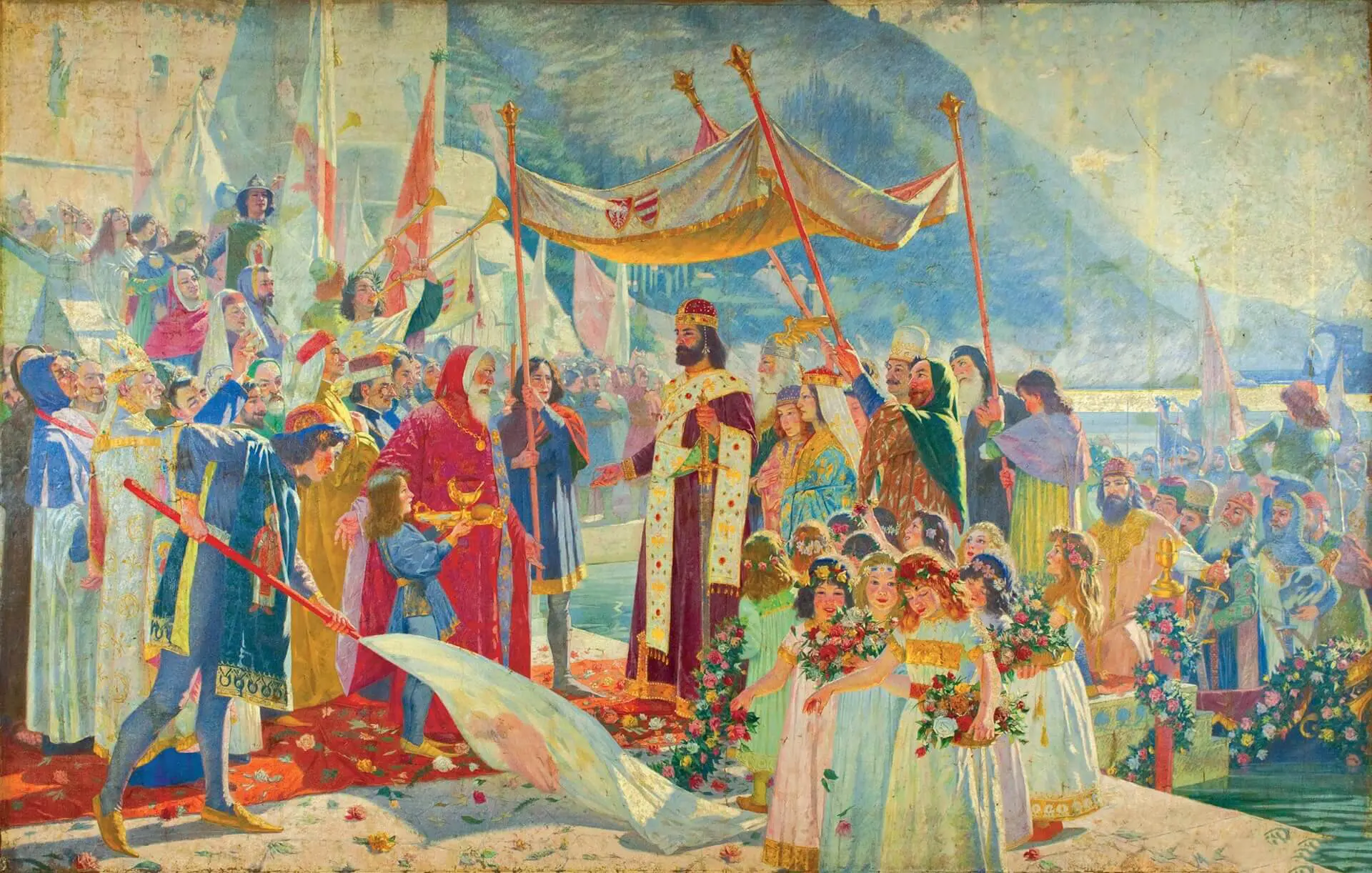
This painting, by Marko Murat in 1900, depicts the grand 14th-century visit of Tsar Dušan to the Adriatic port of Dubrovnik, evoking both the splendour of the medieval Serbian Empire and the height of its outward-looking diplomacy. The painter himself is hidden among the welcoming crowd, taking his place as a witness to history.
The event itself stood as a symbol of the Empire’s zenith and its diplomatic prestige abroad. Dubrovnik at the time was a flourishing trading city-state, and Dušan’s visit marked the reach of Serbian sovereign power into the Mediterranean world.
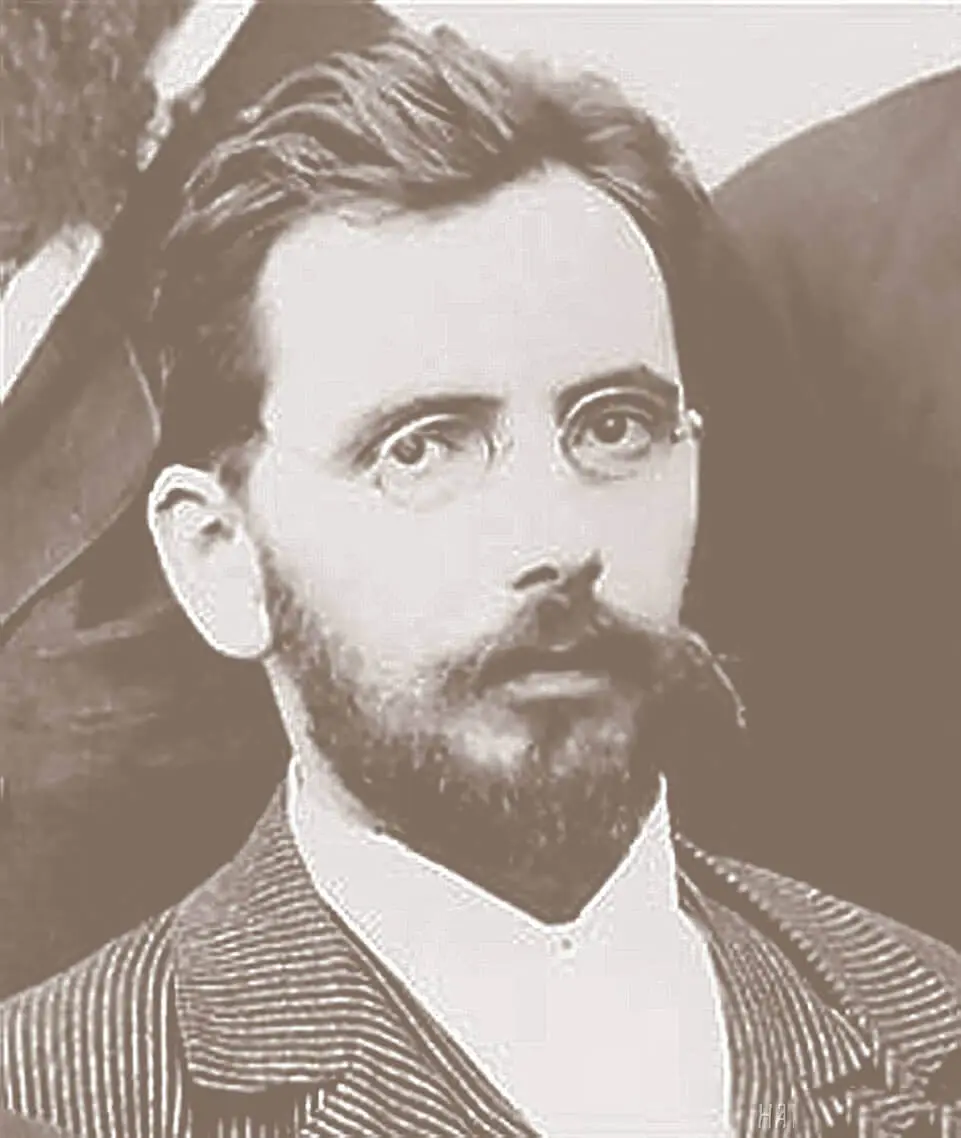
Marko Murat
🖼️ A closer look at the painting:
- The central figure: Emperor Dušan, in a golden royal robe and imperial crown, receives ceremonial honours at the end of the red carpet, his bearing majestic.
- On the left: nobles of Dubrovnik and representatives of the Church receive the Tsar with full ceremony, presenting ritual gifts.
- On the right: the Empress is attended by a host of ladies-in-waiting, while children scatter flowers in welcome, creating an atmosphere of joy and reverence.
- In the foreground: children, garlands and ceremonial guards, all rendered with vivid detail in a setting of grand pageantry.
- Banners overhead: largely the symbols of Serbia and Dubrovnik, reinforcing the imagery of state.
- The overall palette: bright and richly saturated, full of festive feeling, underscoring the themes of cultural exchange and peace.
👤 The artist’s self-portrait, hidden in plain sight:
According to scholarly research, the painter Marko Murat very likely concealed himself on the left of the painting, in the figure of a man in a red cloak among those bearing the canopy. He is not looking directly at the Emperor, but recording the scene from a level, slightly detached vantage point.
It is the gesture of an artist saying “I was on the spot in history,” echoing Paja Jovanović’s self-image left behind in The Coronation of Tsar Dušan.
📜 Historical and symbolic meaning:
- A celebration of the political and cultural glory of Dušan’s reign;
- An evocation of Serbia’s ties with the states of the Mediterranean;
- An image of diplomatic wisdom in which peace and authority are held together;
- Within Serbian cultural history it functions as part of the national narrative, carrying the memory of the “medieval golden age.”
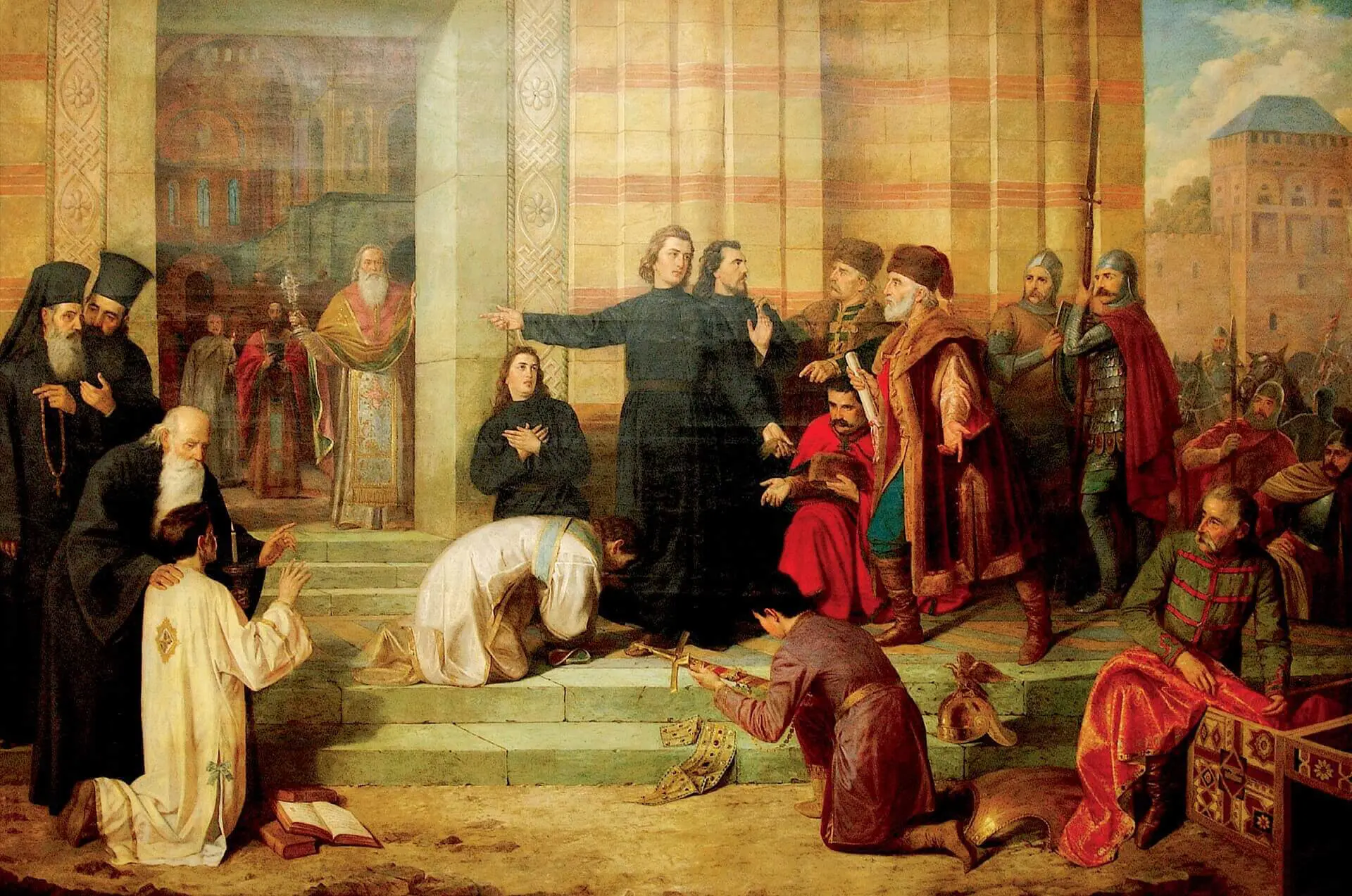
This painting, The Tonsure of Saint Sava (in Serbian: “Postriženje Svetog Save”), is the work of Stevan Steva Todorović (1832–1925), and ranks among the most important Serbian Romantic history paintings of the 19th century.
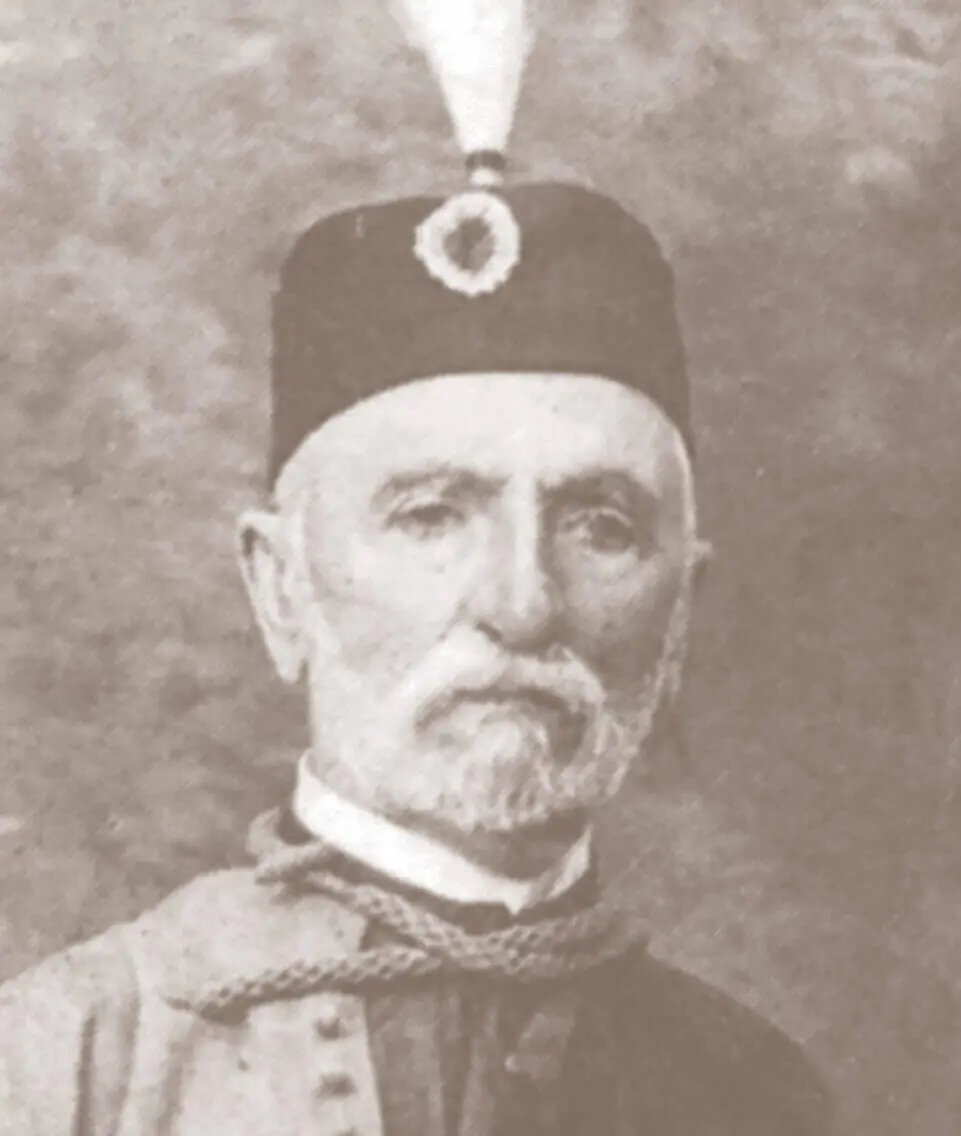
Stevan Steva Todorović (1832–1925)
🎨 Background of the work
- Title: The Tonsure of Saint Sava
- Painter: Steva Todorović
- Date: early 20th century, a monumental late work painted when Todorović was already in his seventies
- Dimensions: about 18 square metres (a vast historical canvas)
- Subject: the sacred historical moment in which the Serbian prince Rastko (later Saint Sava) renounces the throne, accepts the monastic tonsure, and sets out on the spiritual path.
- Style: Romanticism, with a dramatic composition and meticulously detailed realism.
👑 Reading the painting
-
Saint Sava (the young prince):
- The young man in black, kneeling to receive the tonsure (the central figure on the left), embodies the resolute renunciation of worldly power and the dedication of his life to faith.
- This is Prince Rastko Nemanjić, who after taking monastic vows was venerated as the founding father of the Serbian Orthodox Church — Saint Sava.
-
The reaction of family and court:
- Beside him, an elderly man stands grieving yet reverent, while a number of courtiers express disbelief or opposition (the figures on the right).
- The figure in the red robe is most likely his father, Stefan Nemanja, expressing both the disappointment and the deep respect of the royal house toward the young prince.
-
Symbols and details:
- The crown and armour on the ground signify that he has voluntarily relinquished royal power;
- The clergyman in episcopal vestments behind him receives him into the Church;
- Todorović himself is painted into the lower right of the canvas, in the role of an elderly general, present as a witness to the event (just as we have spoken of artists “hiding within their own paintings”).
🧾 Cultural and historical significance
This work is not only the summit of Todorović’s artistic achievement; it is also a kind of visual monument, underscoring the inseparable bond of religion, nation and family in Serbian culture. The figure of Saint Sava stands for faith placed above worldly position, while the painter’s “self-portrait” gives the work both a documentary character and the weight of personal feeling.
A few examples:
- Michelangelo, in The Last Judgment in the Sistine Chapel, painted himself as the flayed skin held by Saint Bartholomew.
- Caravaggio, in his great canvas of the martyrdom of Saint Matthew, cast himself as a helpless witness to the scene.
- Velázquez, in his history painting The Surrender of Breda, painted himself as a soldier standing beside the Spanish king, at the far right of the composition.
- Rembrandt, too, painted himself into The Raising of the Cross, as a man in a hat helping to lift the cross.
Serbian painters could not resist either
This way of working found its way into Serbian painting as well. Several examples are preserved in our national museum and galleries:
- Pavle Simić (1818–1876), one of the leading representatives of the Vienna academy’s “Nazarene” school, was from Novi Sad. He produced a great number of icons and portraits, and likewise devoted himself to scenes drawn from national history. In his 1849 painting Hadži Ruvim and Hadži Đera, he placed himself at the far left of the canvas, by a window, as a participant in the historical event — the painting depicts Hadži Ruvim drafting a letter to the Ottoman Sultan on the eve of the First Serbian Uprising. In fact, even earlier, in 1848, he had already painted himself into The May Assembly at Sremski Karlovci.
-
Novak Radonić (1826–1890) was both a painter and a writer, and a devotee of Romanticism. Before he was even thirty, he had come to feel that, talented though he was, he would never be good enough. Returning from his travels in Italy, where he had stood before the works of the Renaissance and Baroque masters, he often spoke in tones of self-rejection:
Perhaps it was for this reason that, while still a young man, he assigned himself the role of executioner within his own painting — in The Stoning of Saint Stephen he placed himself among those holding stones on the right, as if asking forgiveness for dreams he knew he would never be able to fulfil.“When I see the works of those painters, I no longer want to be a painter myself.”
- Steva Todorović (Stevan Steva Todorović, 1832–1925), by contrast, was a quite different figure: a far more energetic and engaged painter. During the national revival of the mid-19th century he made an enormous contribution to the cultural life of the Principality of Serbia. In his old age, after he had passed seventy, he produced the monumental Tonsure of Saint Sava, a painting of some 18 square metres. Within it he depicted himself as an aged duke, holding out the symbols of power to the young Prince Rastko and trying to persuade him to think again about taking monastic vows. It is at once a commemorative work and a kind of “painted testament” of self-expression.
-
At the 1900 Paris Universal Exposition, the pavilion of the Kingdom of Serbia presented two strikingly large works:
- The Coronation of Tsar Dušan by Paja Jovanović (1859–1957)
- The Arrival of Emperor Dušan in Dubrovnik by Marko Murat (1864–1944)
- In The Arrival of Emperor Dušan in Dubrovnik, Marko Murat painted himself as the servant on the right of the composition, holding the canopy — a man with a turban around his head, watching the Emperor enter the city.
-
Paja Jovanović was more discreet. Among the emissaries on the left of the canvas he placed a man with long hair, a beard and thick eyebrows, bearing a striking likeness to himself. Unlike the other figures, whose gaze is fixed on the Emperor, this man looks off into the distance. It may well be a riddle the painter set for posterity.
This figure looks at once like the painter himself and like one of the noblemen he had previously portrayed (King Milan, perhaps), and may even be a quiet jab at “a customer who once commissioned a tapestry but, owing to gambling or unpaid debts, never settled the bill.”
In closing
Paja Jovanović was a master of beauty and flattery, and equally a master of disguise and concealed messages. What these painters left behind for posterity, with their brushes, is not merely history, but the cipher of their own personal stories.
— Petar Petrović